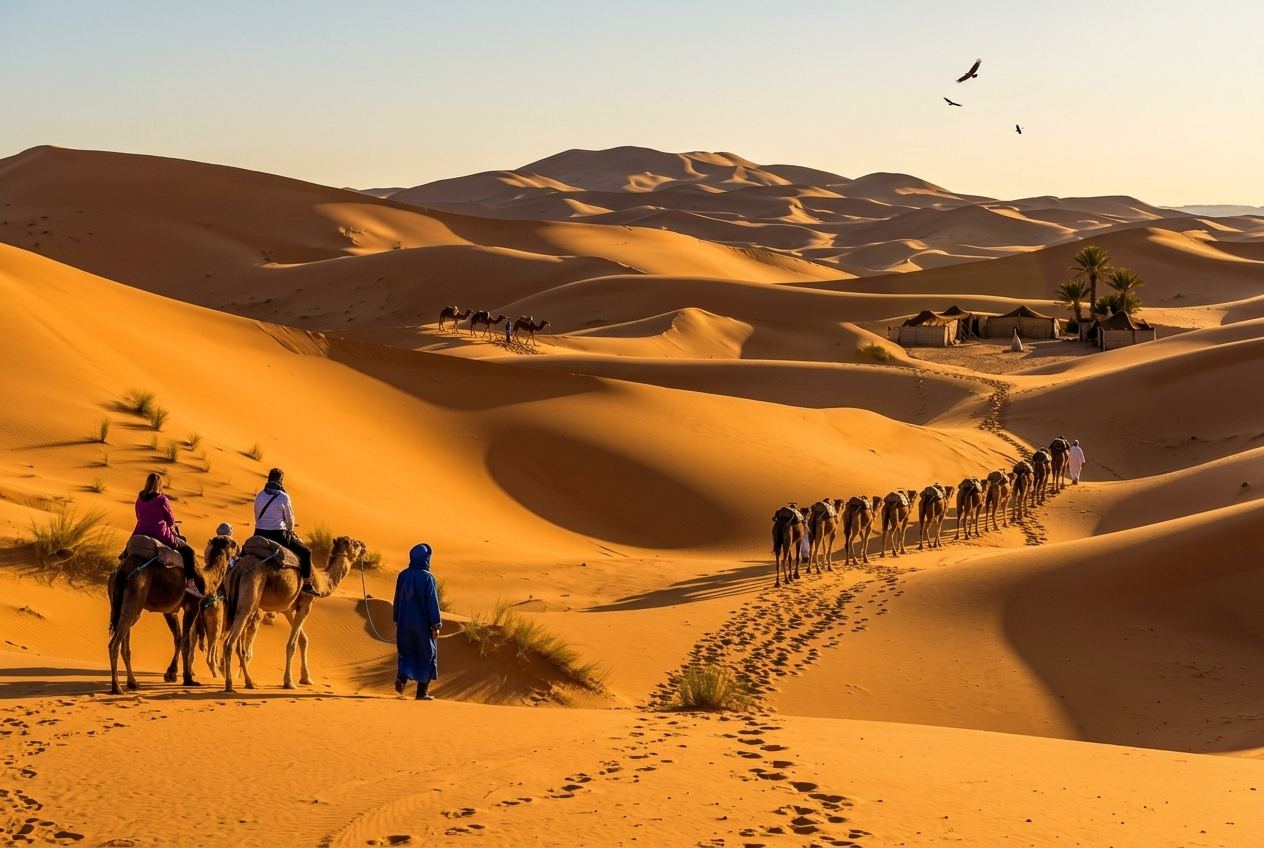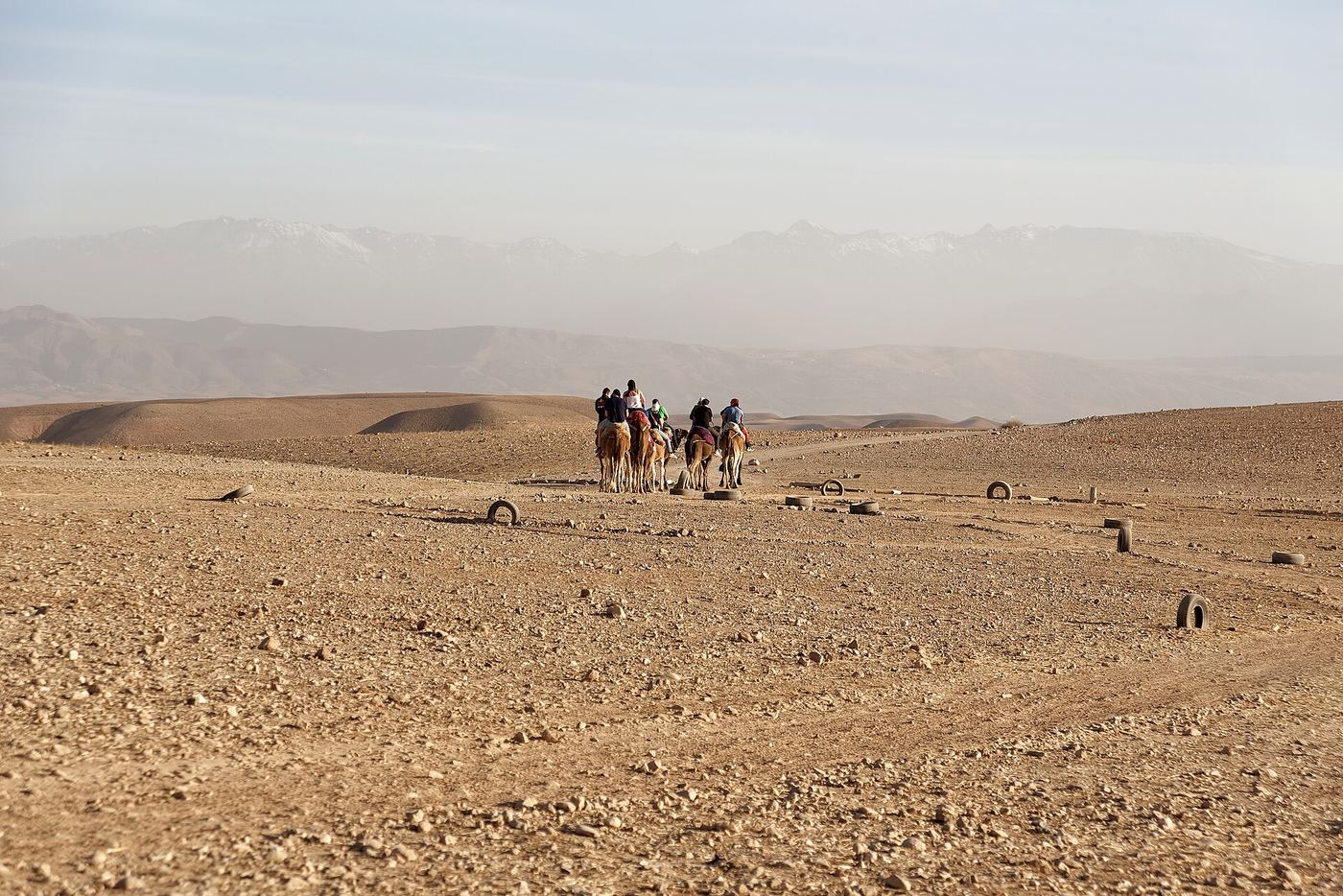
Laâyoune is the largest city in the Moroccan Sahara and the administrative and cultural heart of the southern provinces. This rapidly expanding Saharan city offers a fascinating face of deep Morocco, where Hassani culture and the Atlantic desert meet in an unexpected modernity.
Laâyoune, administrative capital and metropolis of the Moroccan Sahara
Laâyoune (Al Aaiun in Arabic) is the capital of Morocco's Saharan provinces with a population of over 250,000. Founded by the Spanish in 1938 as a military post in Spanish Sahara, it transformed into a regional metropolis after the city's return to Morocco in 1975. Today, Laâyoune is a modern city with wide avenues, monumental fountains and recent public facilities, the result of massive Moroccan state investments in the development of the southern provinces.
The Mechouar square, the symbolic heart of the city, is a vast public space surrounded by official buildings and a lively souk. Laâyoune is linked to the rest of Morocco by a 580 km national road to Agadir (6h30 drive) and by Hassan I Airport which operates daily flights to Casablanca and Agadir. The city benefits from growing tourist investments with the opening of new hotels and cultural centres.
The great mosque and the Saharan architecture of Laâyoune
The great mosque of Laâyoune, inaugurated in 1998, is one of the most impressive religious buildings in the Moroccan Sahara. Its architecture combines classical elements of Moroccan architecture (zelligues, mosaics, sculpted cedar) with Saharan and Hassani influences, creating a unique hybrid style. The mosque can accommodate up to 10,000 worshippers and its 45-metre minaret is visible from most points in the city.
The architecture of Laâyoune illustrates the synthesis between northern Moroccan construction styles and Saharan architectural traditions. Public buildings and wealthy private residences use white concrete as the main material, with decorative elements borrowed from Hassani architecture: ogival arches, geometric claustras, inner courtyards with palms. This architectural modernity coexists with older quarters of low banco houses characteristic of the Sahara.
Hassani culture: music, haima tent and nomad tea
Hassani culture — specific to the Arabic-speaking Sahrawi populations of the Moroccan Sahara — is a culture of nomadism and hospitality. The haima (large tent in camel wool or cotton) is the central social space, the place for gatherings, celebrations and welcoming visitors. Sitting on embroidered cushions around the traditional meal of dried camel meat (lahm gueddid) or fish couscous, Sahrawi families share news and tell stories over green mint tea prepared in three progressively stronger infusions.
Hassani music, played on the tidinit (four-string lute) and the tbel (large drum) by griots (iggawen), is a living tradition that recounts genealogies, warrior epics and love poems. Sahrawi culture festivals in Laâyoune allow visitors to attend these musical performances. Tour Come Morocco organises meetings with Sahrawi families who share their culture and offer authentic hospitality, in respect of traditions.
The dunes of Foum El Oued and the landscapes of the Atlantic desert
25 km north of Laâyoune, the dunes of Foum El Oued advance towards the Atlantic in a landscape unlike any other: golden sand dunes facing the ocean waves, with a strip of wild beach separating them. This phenomenon — the desert meeting the ocean — is unique in the world and creates extraordinary visual contrasts, particularly at sunrise and sunset when the raking light colours the dunes in orange and red.
The Atlantic coast around Laâyoune is renowned among the best surf casting fishing spots in Morocco. Bass, grouper and sea bream are caught directly from the edge of the dunes in waters rich in nutrients thanks to the North Atlantic upwellings. Tour Come Morocco organises 4x4 excursions to Foum El Oued at sunrise, with a Sahrawi breakfast in a haima pitched facing the dunes and the Atlantic.
How to reach Laâyoune from Agadir or Dakhla
Laâyoune is accessible from Agadir (580 km, 6h30 drive) via national road RN1, the main axis of Atlantic Morocco which crosses Tiznit, Guelmim and Tan-Tan. This road is in excellent condition and crosses increasingly Saharan steppe and desert landscapes over the kilometres. Comfortable CTM company buses make the daily link from Agadir, Marrakech and Casablanca. Laâyoune's Hassan I Airport also operates flights from Casablanca and Agadir.
From Dakhla in the south (360 km, 4h drive), the road follows the Atlantic between desert and ocean in one of the most epic landscapes of the Moroccan Sahara. Tour Come Morocco offers turnkey Saharan circuits of 5 to 7 days from Agadir, covering Laâyoune, the Foum El Oued dunes, Dakhla and its lagoon, for a complete immersion in Morocco's great Atlantic Sahara.
Want to live this trip?
Our driver-guides organise everything for you. Free quote in minutes.
Free quote on WhatsApp